The plain front to everything 4i.
The whole 4i advantage in one place, so you get it without navigating the site — plus short pieces on how to think about the agentic shift, and on what's happening now that matters to a company like yours. Built to be added to.
One idea per entry, told plainly. Each piece links to the page that goes deep — so the library stays simple, and the detail is one click away when you want it.
The whole argument in five minutes — start with one workflow, proven on the IBM i you already own.
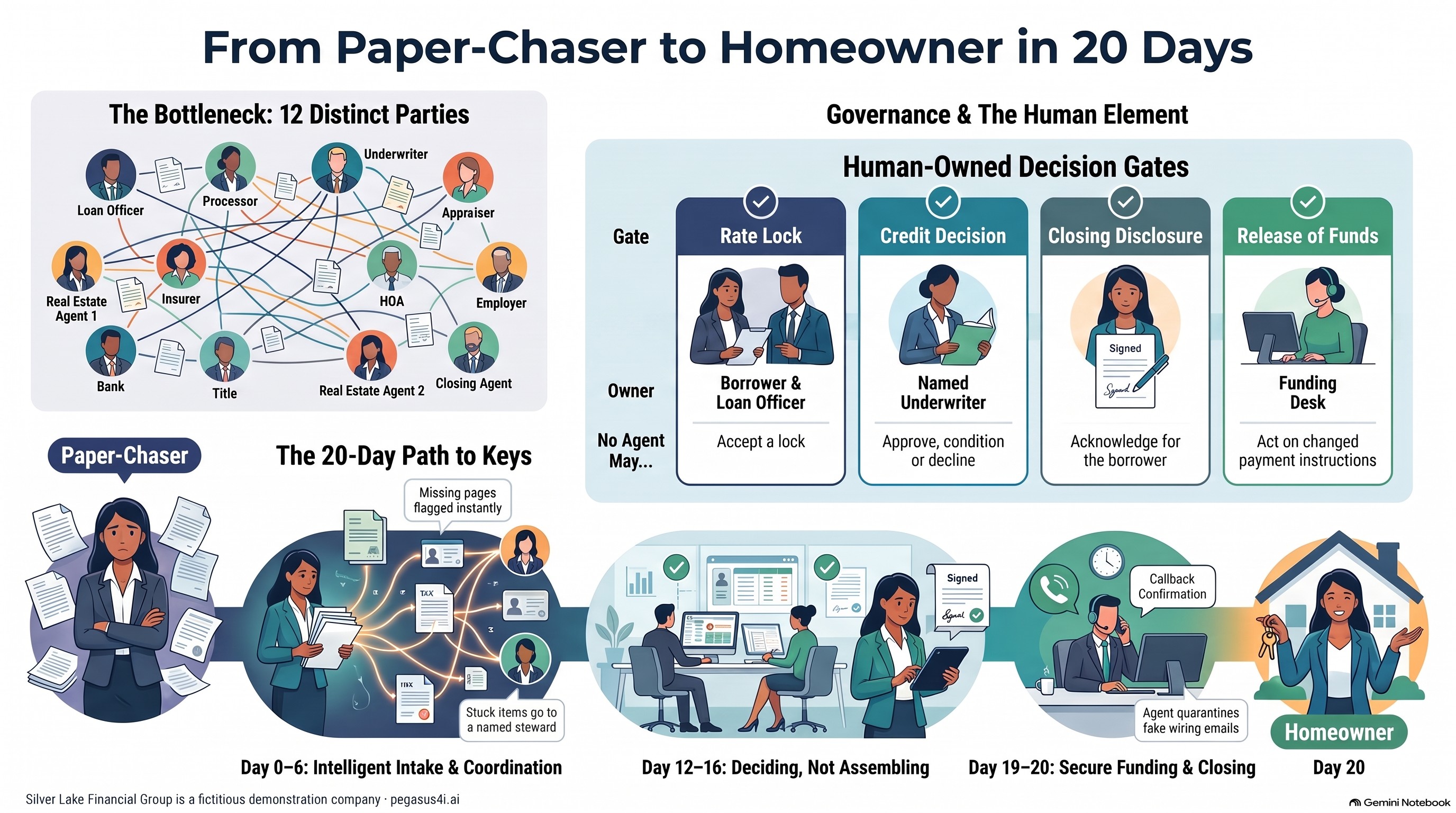
A dozen people touch a home loan. Follow Maya, a first-time buyer, through one where agents do the chasing and four named people make the decisions that bind. The same pattern fits any process where many hands touch one decision.
Part 2 · The gates and Part 3 · Inside the lender, below. Silver Lake Financial Group is a fictitious demonstration company.
The same loan, with the hood open. Five scoped agents, each with its own identity and a firm list of what it may never do. Four gates owned by named people. One append-only ledger, and IBM i kept as the system of record. For IT, architecture, risk and compliance.
What changes for the people when agents take the chasing. The loan officer moves to advice, the processor owns exceptions, the underwriter decides on complete files. The goal was never fewer people; it was moving people up to the work that needs judgment. For operations and business leaders.
Silver Lake Financial Group is a fictitious demonstration company; its people and their words are illustrative.
If you read one thing, read this — the whole advantage as one argument: why now, what we bring, and how it runs.
The 4i Advantage
Build your agentic capability and thrive as an agentic IBM i org. Why the real work is organizational and human — not just the tools — the intelligence you already own, the one team that carries every part of the change, and the process that proves one piece and compounds it. Told in three acts.
Read → Watch the videoDeep dives into one aspect of the advantage at a time, plus short pieces on how to think about the shift and what's happening now that matters to you. Added over time.
The Bob Chronicles
An independent IBM i read on IBM Bob: what it does, what it means for a shop like yours, and how to put it to work. Newest, chapter 03: governing Bob on IBM i, from the profile it uses to the audit record it leaves. Chapters 01 and 02 cover Bob running in-house and what it does with RPG.
Four named it. The platform already answered.
Four observers named this year's AI failure four different ways. The answer each of them circled is a discipline the IBM i world has run since 1988 — the sovereign core, the seam, and why the platform is one strand of three.
You can't bolt onto a watch
An IBM i shop is a fine watch that's kept perfect time for forty years — which is exactly why you can't strap agents onto the outside of it. The applied read on why the org reshapes rather than bolts on, and how the pilot stands up beside the running movement.
Governance is the human. The gate is the platform.
Peter Diamandis says the human moves above the loop. On IBM i, that's only possible because the gate is enforced in the platform, not carried by a person. Governance above; the gate below; no one stranded in the flow.
ExO 3.0 — the method behind the shift
Your organization was designed for people doing all the work — every reporting line and hand-off assumes a person at both ends. ExO 3.0 is the discipline for re-imagining that work for people and agents together, with people holding the judgment. The deep look at the method the org shift runs on. Drawn from Salim Ismail's The Organizational Singularity.
How to think about the agentic shift
Plain takes on the concepts underneath the work — the ideas a decision-maker needs to hold to lead the change, not just approve it.
Signals from the wider world
The moments out in the market that matter for a company like yours — read for what they mean for an IBM i shop, not just reported.
This is the plain front to everything 4i does; each piece links to the fuller page when you want the detail. The framework underneath lives at humanorgtech.ai, and the longer essays at reggiebritt.ai.
Built In.
One idea, one proof, one next step. Every two weeks, three minutes. Agent-ready IBM i and agent-native commerce from Pegasus4i.